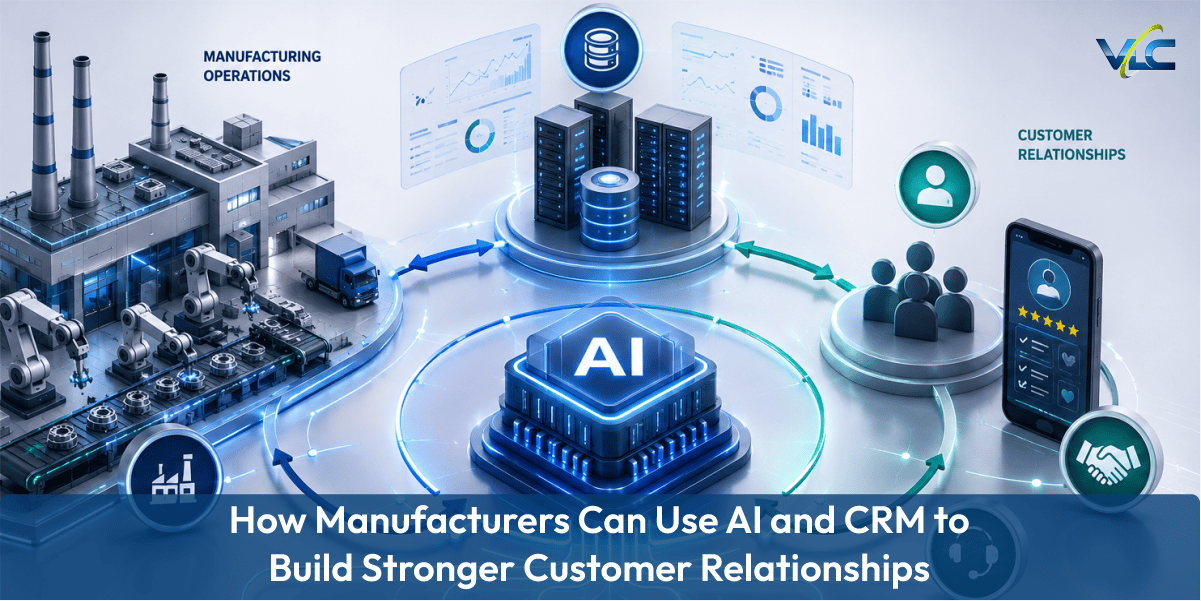
How Manufacturers Can Use AI and CRM to Build Stronger Customer Relationships
For decades, manufacturers operated in a world where the customer relationship was largely transactional. Orders came in, products shipped out, and the conversation ended there. But today’s buyers expect more. More responsiveness, more personalisation, and more proactive partnership. The manufacturers who are thriving are the ones using AI and CRM technology not just to manage customers, but to truly understand and serve them.
The Customer Relationship Gap in Manufacturing
Manufacturing has traditionally been product-focused rather than customer-focused. Sales cycles are long, orders are complex, and customer data is often scattered across spreadsheets, email chains, and disconnected ERP systems. The result? Missed renewal opportunities, reactive service instead of proactive outreach, and a lack of visibility into what customers actually need next.
This gap is costing manufacturers real business. Research consistently shows that it costs five times more to acquire a new customer than to retain an existing one. Yet many manufacturers still underinvest in the tools and processes needed to deepen customer loyalty. AI-powered CRM platforms are changing that equation fundamentally.
What AI Brings to the CRM Table
A traditional CRM captures data. An AI-enhanced CRM interprets it and acts on it. Here is what that looks like in practice for manufacturers:
Predictive Analytics for Demand Forecasting
AI analyses historical purchase patterns, seasonal trends, and industry signals to help sales and account management teams anticipate what customers will need before they ask. A key account manager can walk into a quarterly business review already knowing which product lines the client is likely to expand, rather than waiting for a purchase order to arrive.
Intelligent Lead Scoring and Prioritisation
Not every enquiry deserves the same response speed. AI tools can score incoming leads based on firmographic data, behavioural signals, and past conversion patterns, helping sales teams focus their energy on the opportunities most likely to close. For manufacturers with long and complex B2B sales cycles, this is a significant efficiency gain.
Automated, Personalised Communication
Manufacturers often serve thousands of customers across different industries and geographies. AI makes it possible to personalise outreach at scale, sending the right follow-up email, the right product recommendation, or the right service reminder at the right time, without requiring a sales rep to manually manage every touchpoint.
Churn Prediction and Early Warning Systems
AI models can detect warning signs of customer dissatisfaction like reduced order frequency, longer payment cycles, decreased engagement with communications, and flag these accounts for proactive outreach before a competitor has the chance to move in.
Turning CRM Data into Genuine Relationships
Technology on its own does not build relationships. People do. But AI and CRM platforms give manufacturers the intelligence and infrastructure their people need to have better, more meaningful conversations with customers.
When a sales representative walks into a client meeting equipped with a full view of that customer’s order history, service requests, pain points, and future needs, all surfaced by an AI-powered CRM, they are no longer a vendor. They become a trusted partner who understands the client’s business deeply.
This shift matters enormously in manufacturing, where relationships are often the differentiating factor in a competitive market. When products and pricing are comparable, the manufacturer who knows their customer best wins.
Integration Is Everything
The value of AI and CRM in manufacturing depends heavily on integration. A CRM that does not talk to your ERP system, your supply chain data, or your service management platform will always be working with incomplete information. Manufacturers must invest in connecting these systems so that the customer view is truly 360 degrees, spanning the full lifecycle from initial enquiry through order, fulfilment, service, and renewal.
This is where implementation partners with deep manufacturing expertise become essential. The configuration, data migration, and change management required to make AI and CRM work in a manufacturing context are not trivial. Done well, it transforms operations. Done poorly, it creates yet another siloed system that teams stop using within six months.
Starting the Journey
For manufacturers who are early in their CRM and AI journey, the advice is simple: start with the customer problems you already know you have. Are you losing customers to competitors without understanding why? Are your renewal rates lower than they should be? Are your sales teams spending too much time on administration instead of relationships?
Choose the business challenge first, then select the technology that solves it. Map out your data sources, identify the integrations you need, and build a roadmap that delivers quick wins alongside longer-term transformation.
The manufacturers who will lead their markets in the next decade are the ones investing now in the tools, processes, and skills needed to make every customer interaction smarter, faster, and more human.
AI and CRM will not replace the relationships that manufacturing runs on. They will make those relationships stronger than ever before.
VLC helps manufacturers implement and optimize CRM and AI-powered solutions that drive real customer outcomes. Get in touch to find out how we can support your transformation journey.