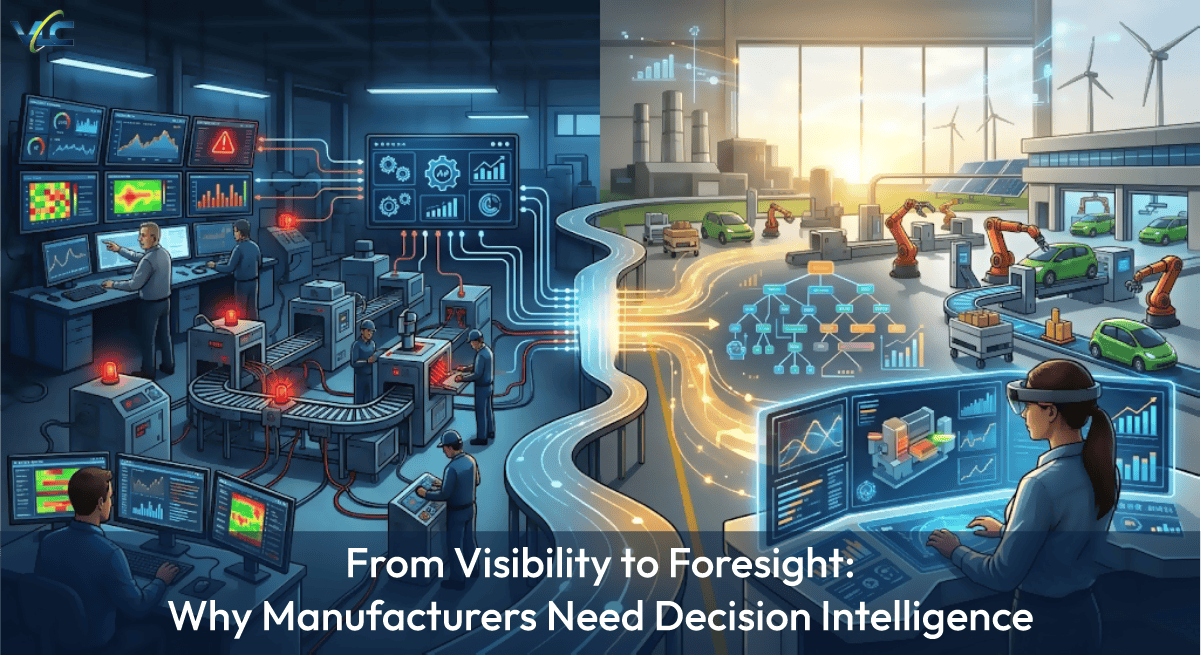
From Visibility to Foresight: Why Manufacturers Need Decision Intelligence
Manufacturers have never had access to more data. Production systems track machine performance. ERP platforms capture orders and inventory. Supply chain systems monitor suppliers and shipments. Workforce platforms provide labor information. Sensors generate streams of operational data every second. And yet, one question continues to challenge manufacturers:
What should we do next?
Knowing what happened yesterday or what is happening right now is valuable. But in an environment where demand shifts quickly, supply chains remain unpredictable, and production constraints can emerge without warning; visibility alone is no longer enough. Manufacturers need to move from simply seeing what’s happening to anticipating what’s next.
This is where decision intelligence is emerging as the next evolution of intelligent manufacturing.
Visibility Is Only the Beginning
For years, manufacturers have invested in dashboards, reporting tools, ERP systems, and business intelligence platforms to gain greater operational visibility. These technologies answer important questions: How much are we producing? What is in the inventory? Which orders are delayed? How are machines performing?
But visibility is fundamentally retrospective or descriptive. A dashboard might tell a production manager that a work center is operating below capacity. It may not explain how a sudden supplier delay, changing customer demand, workforce shortage, or maintenance issue could affect production three days from now.
The challenge is no longer simply accessing data. It is connecting the signals hidden within that data.
From Analytics to Foresight
The next step is moving from descriptive analytics toward predictive and prescriptive intelligence. Imagine a manufacturer receives an unexpected increase in demand for a particular product. That change doesn’t affect production alone. It could impact raw material requirements, supplier schedules, machine capacity, workforce allocation, inventory levels, delivery commitments, and even other customer orders.
Traditional systems may show each of these variables separately. Decision intelligence connects them. By applying AI and advanced analytics across these interconnected data points, manufacturers can identify patterns, predict potential constraints, simulate different scenarios, and determine which actions are most likely to deliver the desired outcome.
The progression is powerful:
Visibility: What is happening?
Analytics: Why is it happening?
Prediction: What is likely to happen?
Decision intelligence: What should we do next?
That final step is where manufacturing intelligence starts creating real business value.
Why Manufacturing Needs Connected Intelligence
Manufacturing decisions rarely happen in isolation. A procurement decision can influence production. Production decisions affect inventory. Inventory affects customer fulfillment. Workforce availability affects capacity. Supplier performance influences scheduling. A change in customer demand can ripple across the entire operation. This interconnectedness makes manufacturing particularly well suited to AI-driven decision intelligence.
Instead of optimizing individual processes independently, manufacturers can begin looking at the entire decision chain. For example, rather than simply identifying that production capacity is becoming constrained, an intelligent system could analyze demand forecasts, current orders, available materials, machine capacity, workforce availability, and delivery commitments to recommend the best production sequence. The objective isn’t simply to generate another report. It is to help people make better decisions faster.
The Human Role Isn’t Disappearing
One of the biggest misconceptions around AI in manufacturing is that intelligent systems are designed to replace human expertise. The more valuable opportunity is to augment it. Experienced planners and production managers understand nuances that aren’t always captured in a database. They know which suppliers are reliable, which machines tend to behave differently, and which operational trade-offs are realistic.
Decision intelligence doesn’t eliminate that expertise. It gives it a stronger foundation. Instead of spending hours collecting information and manually comparing scenarios, teams can focus on evaluating recommendations, applying their experience, and making strategic decisions. In other words, AI can take on more of the information complexity, while people remain responsible for the business judgment.
From Prediction to Intelligent Action
The evolution doesn’t stop at prediction. As AI becomes more capable, manufacturers are moving toward systems that can not only identify what might happen but also recommend or initiate appropriate actions. This is where agentic AI could take intelligent manufacturing even further.
An AI agent could monitor production and supply chain conditions, identify an emerging constraint, evaluate available options, and initiate a workflow based on predefined business rules, while keeping human teams involved when decisions require judgment or approval.
That creates a new model of manufacturing operations:
Sense → Understand → Predict → Decide → Act.
The result is a more responsive enterprise that can adapt as conditions change instead of waiting for problems to become disruptions.
Building the Intelligent Manufacturing Enterprise
Getting there requires more than adding an AI tool to an existing technology stack. Manufacturers need connected business systems, reliable data, integrated operational information, and a technology foundation capable of supporting AI-driven intelligence. ERP, production, inventory, supply chain, workforce, and customer data need to work together rather than remain trapped in separate systems.
This is where the broader concept of Enterprise Intelligence is important. The goal isn’t simply to make one production process smarter. It is to create an environment where intelligence can flow across the business, helping leaders and teams understand relationships between decisions and outcomes.
For manufacturers, that means moving beyond asking “What happened?” and “What’s happening?” The more important questions become:
“What’s likely to happen next?”
And ultimately: “What should we do about it?”
The Future Is More Than Visibility
Manufacturing has spent years building systems that give businesses greater visibility. The next competitive advantage will come from turning that visibility into foresight. AI, predictive analytics, connected data, and eventually agentic systems can help manufacturers anticipate constraints, evaluate scenarios, optimize decisions, and respond faster to change.
The manufacturers that thrive won’t necessarily be those with the most data. They’ll be the ones that can turn their data into intelligence, intelligence into decisions, and their decisions into action. That’s the real shift from visibility to foresight.
VLC helps manufacturers connect business systems, operational data, AI, and intelligent workflows to improve decision-making and optimize operations. Explore VLC’s AI-powered manufacturing solutions and move from visibility to intelligent action.