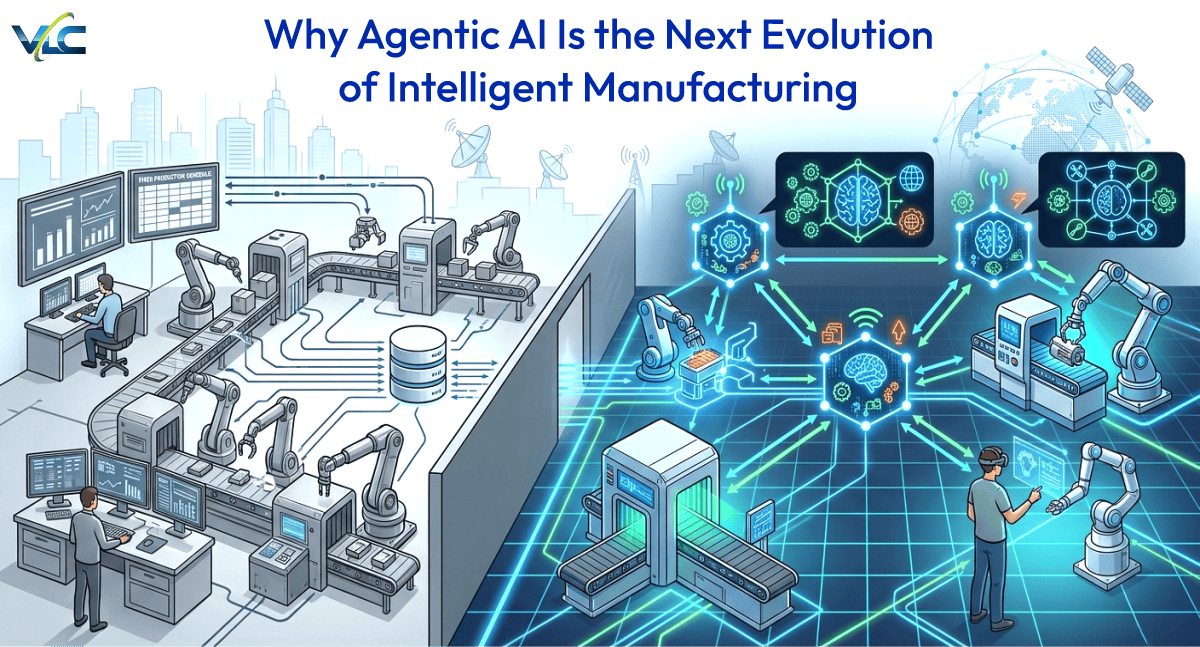
Why Agentic AI Is the Next Evolution of Intelligent Manufacturing
“The best factories of the next decade won’t simply automate work. They’ll know what needs to be done before anyone asks.”
Manufacturing Has a People Problem and Not a Technology Problem
Walk through almost any manufacturing plant today, and you’ll hear the same concerns repeated in different ways.
“Our most experienced supervisor is retiring next month.”
“We spend too much time chasing updates instead of solving problems.”
“Every department has the information but nobody has the whole picture.”
For years, manufacturers have invested heavily in automation. Machines have become faster. Production lines have become smarter. ERP systems have become more connected. Yet one thing hasn’t changed enough: people are still expected to stitch everything together.
Managers chase approvals. Planners juggle production schedules. Procurement teams react to shortages. Quality engineers investigate issues after they’ve already affected production.
Automation made processes faster. Agentic AI promises something much bigger as it makes operations smarter. That’s why many industry experts believe Agentic AI represents the next major leap in manufacturing intelligence.
From Automation to Agency
Traditional automation follows instructions. If X happens, perform Y. It’s efficient, but rigid.
Agentic AI introduces something fundamentally different. Instead of simply executing predefined tasks, AI agents understand objectives, monitor changing conditions, coordinate across systems, and recommend, or even execute, the next best action within defined business rules.
Think of them less as chatbots and more as highly specialized digital teammates.
One AI agent might monitor inventory levels while another watches production capacity. A third evaluates supplier performance, while another tracks quality trends. Together, they continuously exchange information to keep operations moving smoothly. Instead of waiting for people to connect the dots, the system begins connecting them automatically.
Manufacturing Is Becoming Too Complex for Reactive Decision-Making
Manufacturing today is far more interconnected than it was even five years ago. A delayed shipment impacts production. A machine breakdown affects delivery commitments. An engineering change modifies inventory requirements. A quality issue creates procurement challenges. Every decision ripples across the organization. The problem isn’t a lack of data.
Manufacturers already have enormous amounts of operational information sitting inside ERP systems, warehouse applications, quality records, maintenance logs, and supplier databases.
The challenge is turning that information into action quickly enough. This is where Agentic AI changes the equation. Instead of presenting another dashboard for someone to interpret, intelligent agents monitor operations continuously, recognize emerging issues, evaluate possible responses, and surface the actions that matter most. Leaders spend less time searching for information and more time making strategic decisions.
AI That Works Alongside People
One of the biggest misconceptions surrounding AI is that it’s designed to replace people.
In reality, the most successful manufacturers are using AI to amplify human expertise, not eliminate it. Experienced production managers possess years of operational knowledge. Maintenance engineers understand subtle machine behaviors. Procurement specialists know which suppliers consistently deliver under pressure.
These insights are incredibly valuable. Agentic AI helps preserve and scale that knowledge across the organization. When experienced employees retire or move into new roles, their expertise doesn’t disappear with them. Instead, AI-supported workflows help standardize best practices, improve consistency, and reduce dependence on tribal knowledge.
People remain in control. AI simply helps them make better decisions, faster.
Governance Matters Just as Much as Intelligence
Greater autonomy doesn’t mean giving AI unrestricted authority. Manufacturing environments require strict controls, compliance, and accountability. The best Agentic AI systems operate within clearly defined business rules. They follow approval hierarchies.
They respect quality standards. They comply with procurement policies. They maintain complete audit trails. Every recommendation and every automated action remains transparent and traceable. That’s what makes autonomous operations practical rather than risky.
Trust isn’t created by removing governance. It’s created by embedding governance into every intelligent decision.
The Intelligent Factory Is Built on Connected Systems
AI agents are only as effective as the information available to them. Disconnected applications, spreadsheets, manual data entry, and isolated departments limit AI’s potential. That’s why manufacturers are increasingly focusing on connected digital ecosystems rather than standalone AI tools.
When production planning, inventory, quality management, engineering changes, warehouse operations, maintenance, and compliance all operate within an integrated environment, AI gains the context needed to deliver meaningful insights.
Instead of isolated recommendations, organizations receive coordinated intelligence across the entire manufacturing operation. This transforms AI from a productivity tool into a business capability.
The Future Is In Smarter Teams
The conversation around AI often focuses on machines replacing people. Manufacturing tells a different story. The real opportunity lies in reducing repetitive coordination, minimizing manual decision-making, eliminating operational blind spots, and giving employees the information they need exactly when they need it.
Imagine supervisors spending less time gathering updates and more time coaching teams. Engineers focusing on innovation rather than paperwork. Quality managers preventing problems instead of investigating them afterward.
Executives making decisions based on live operational intelligence instead of yesterday’s reports. That’s the future Agentic AI is enabling. Not fewer people. Smarter work.
How VLC Helps Manufacturers Prepare for Agentic AI
Agentic AI isn’t something businesses simply “switch on.” It requires connected systems, trusted data, and intelligent business processes. That’s where VLC helps manufacturers build the right foundation.
Built on Microsoft Dynamics 365 Business Central, VLC’s manufacturing solutions connect the operational functions that AI depends on.
Solutions like Production Optimization help improve throughput using AI-powered recommendations. Smart Warehouse Management provides real-time inventory visibility across warehouse operations. Quality Management ensures inspections and compliance remain embedded throughout production.
When information moves together, intelligent decision-making follows naturally. That is the foundation upon which Agentic AI delivers real business value.
The New Competitive Advantage Is Intelligence
Manufacturing has always evolved through innovation; from mechanization to automation, from digitization to connected factories.
Agentic AI is the next chapter in that evolution. It’s not about replacing workers or handing over the factory to machines. It’s about giving every employee, manager, and executive access to the intelligence they need to make better decisions in real time.
The manufacturers that thrive over the next decade won’t necessarily be those with the most robots or the biggest AI budgets. They’ll be the ones that combine human expertise, connected operations, and intelligent systems into a single, adaptive enterprise.
The future of manufacturing won’t simply be automated.
It will be agentic, connected, and intelligently human.
Talk to VLC today and discover how connected manufacturing can prepare your business for the age of Agentic AI.