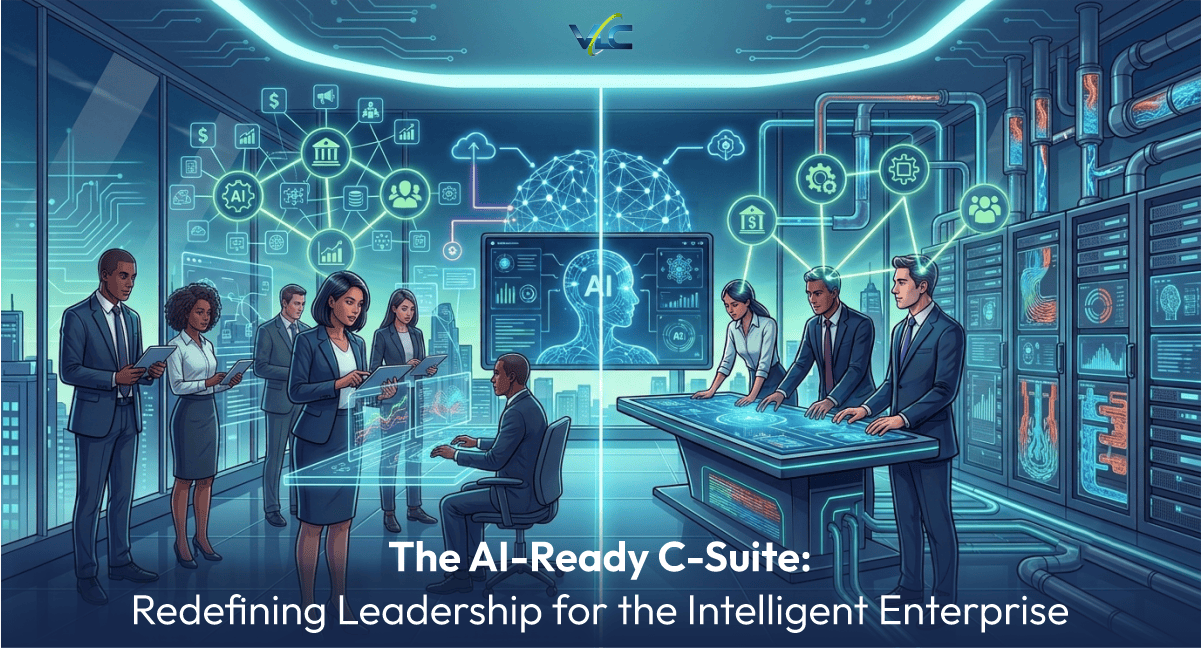
The AI-Ready C-Suite: Redefining Leadership for the Intelligent Enterprise
Artificial intelligence has quickly moved beyond the realm of experimentation. What was once viewed as a tool for automating repetitive tasks is now becoming a strategic driver of growth, resilience, and competitive advantage. As AI becomes deeply embedded in business operations, it is also reshaping one of the most important functions within any organization: leadership.
Today’s executives are expected to navigate economic uncertainty, supply chain disruptions, cybersecurity risks, evolving customer expectations, and rapid technological change, all at the same time. In this environment, intuition alone is no longer enough. Leaders need timely insights, connected data, and intelligent systems that help them make faster, more informed decisions.
Welcome to the era of the AI-ready C-suite, where leadership is no longer just about managing the present but preparing the enterprise for an intelligent future.
Leadership Is Entering a New Era
For decades, executive decision-making relied on historical reports and quarterly reviews. Business leaders looked at what had happened, analyzed trends, and then determined the next course of action.
Today, that approach is proving increasingly inadequate.
Markets shift overnight. Customer expectations evolve rapidly. Supply chains fluctuate. Operational risks emerge without warning. Businesses need leaders who can anticipate change rather than simply respond to it.
AI makes this possible by transforming vast amounts of operational, financial, and customer data into actionable intelligence. Instead of asking, “What happened?” executives can now ask:
- What is likely to happen next?
- Which operational risks require immediate attention?
- Where are we losing efficiency?
- How can we improve customer satisfaction without increasing costs?
The modern C-suite is moving from retrospective reporting to predictive leadership.
AI Is Changing Every Leadership Function
The impact of AI extends across every executive role, enabling leaders to make decisions with greater speed and confidence.
CEOs gain a broader understanding of organizational performance through connected operational insights, helping align long-term strategy with real-time business conditions.
CFOs are using AI to improve forecasting, identify financial anomalies, monitor cash flow trends, and strengthen planning. Instead of spending time compiling reports, finance leaders can focus on strategic growth initiatives.
COOs benefit from real-time visibility into production, inventory, logistics, and operational performance. AI helps identify bottlenecks before they affect productivity and supports more agile decision-making.
CIOs play an increasingly critical role in ensuring AI initiatives are scalable, secure, and governed responsibly. Their focus extends beyond technology implementation to enabling enterprise-wide innovation.
Rather than operating independently, today’s executive teams are becoming more interconnected, supported by a shared foundation of intelligent data.
The Foundation of an Intelligent Enterprise
AI is only as valuable as the data it receives.
Many organizations still struggle with disconnected systems, manual processes, and inconsistent information spread across departments. These silos limit visibility and prevent leaders from obtaining a complete picture of business performance.
Building an intelligent enterprise starts with connected operations.
When finance, manufacturing, inventory, procurement, quality, and customer data flow through an integrated platform, AI can deliver insights that are timely, accurate, and relevant.
This enables leaders to make decisions based on live business conditions rather than outdated reports.
Connected data also strengthens collaboration. Departments no longer operate in isolation but work from a single source of truth that supports enterprise-wide alignment.
From Operational Data to Strategic Intelligence
AI does more than automate routine tasks. It identifies patterns that might otherwise go unnoticed.
For manufacturers, this could mean recognizing production inefficiencies before they become costly bottlenecks. For finance teams, it may involve detecting unusual spending trends or improving forecasting accuracy. For customer-facing teams, AI can reveal changing buying behaviors and opportunities for stronger engagement.
Instead of drowning in dashboards, executives receive prioritized insights that support strategic action.
The result is a leadership team that spends less time gathering information and more time driving business outcomes.
People Still Lead; AI Simply Makes Them Better
Despite rapid advances in AI, successful organizations recognize that technology does not replace leadership.
Experience, creativity, ethical judgment, and relationship-building remain uniquely human strengths.
AI complements these capabilities by reducing manual analysis, accelerating access to information, and helping leaders evaluate multiple scenarios more quickly.
The organizations achieving the greatest success with AI are those that empower people rather than replace them.
This balance between human expertise and intelligent technology is becoming a defining characteristic of modern leadership.
Preparing the Enterprise for What Comes Next
Becoming AI-ready requires more than deploying new technology.
Organizations must establish connected systems, high-quality data, effective governance, and a culture that embraces continuous learning.
Leaders also need to invest in digital skills, encourage cross-functional collaboration, and create frameworks that allow AI to support and not complicate business operations.
An intelligent enterprise is built through gradual, strategic transformation rather than overnight change.
How VLC Helps Build the AI-Ready Enterprise
At VLC, we believe AI delivers the greatest value when it is integrated into everyday business operations.
Through our Microsoft Dynamics 365 Business Central solutions, we help organizations build the connected operational foundation needed for intelligent decision-making.
Solutions such as Production Optimization leverage AI-powered recommendations to improve manufacturing efficiency, reduce bottlenecks, and support smarter production planning. Visual Scheduling provides greater visibility into capacity and resource allocation, while Smart Warehouse Management helps businesses optimize inventory movement with real-time operational insights.
For organizations focused on quality, compliance, and operational excellence, VLC also offers Quality Management, Maintenance Management, and Governance, Risk & Compliance (GRC), helping businesses improve visibility, streamline workflows, and strengthen decision-making across departments.
Together, these solutions transform operational data into actionable intelligence that empowers leaders at every level.
Leading the Intelligent Enterprise
The AI-ready C-suite isn’t defined by how much technology it adopts. It’s defined by how effectively it combines intelligent systems with human expertise to create lasting business value.
Tomorrow’s most successful leaders will embrace AI not as a replacement for experience, but as an extension of it. They will build organizations where data flows freely, decisions are informed by real-time intelligence, and teams are empowered to innovate with confidence.
As businesses continue their digital transformation journey, one thing is becoming increasingly clear: the future belongs to organizations that are both people-led and AI-enabled.
With VLC as your technology partner, you can build the connected, intelligent enterprise needed to navigate today’s challenges and seize tomorrow’s opportunities.