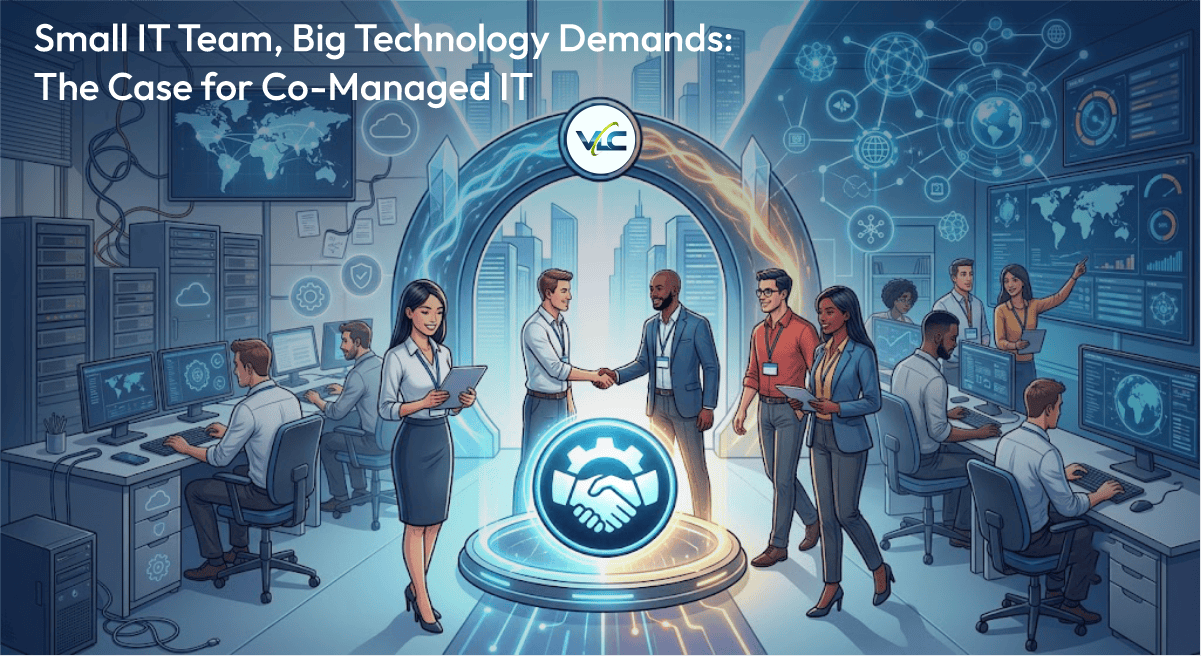
Small IT Team, Big Technology Demands: The Case for Co-Managed IT
There was a time when an SMB’s IT team could focus on keeping the basics running. Make sure systems are available, employees can access what they need, software is updated, and problems get fixed when they arise. That job has changed.
Today, even a small business may be managing cloud applications, cybersecurity, compliance requirements, remote users, business-critical applications, data, infrastructure, backups, and an expanding list of AI initiatives. At the same time, employees expect technology to work seamlessly, leadership wants faster digital transformation, and customers expect businesses to be responsive and secure.
The technology demands keep growing. The IT team often doesn’t.
That creates a difficult question for SMB leaders: How do you expand your technology capabilities without constantly expanding your IT headcount?
For many businesses, the answer is not to hand everything over to an outside provider. It is to bring in the right support alongside the team they already have. That is the thinking behind co-managed IT.
Your Internal IT Team Knows Your Business. They Don’t Have to Know Everything.
An internal IT team has something an external provider can never fully replicate: an intimate understanding of the business. They know the applications employees depend on, the processes that keep operations moving, the systems that are business-critical, and the people who rely on them every day.
That makes internal IT incredibly valuable. But it also doesn’t mean the team needs to handle every technology challenge alone.
A growing SMB may need cybersecurity expertise, cloud support, application management, compliance guidance, infrastructure assistance, or help with a major technology project. Hiring a full-time specialist for every requirement isn’t always practical, particularly when some skills are needed only periodically or when the organization is working with a limited IT budget.
Co-managed IT provides a middle ground. The internal team remains at the center of technology operations while an experienced technology partner supplements its capabilities where there are gaps. The result isn’t internal IT versus outsourced IT. It is internal IT plus additional expertise.
The Firefighting Cycle Is Holding IT Back
One of the biggest problems facing lean IT teams isn’t necessarily a lack of technical knowledge. It’s a lack of time.
When the team is constantly responding to tickets, troubleshooting user issues, dealing with infrastructure problems, monitoring systems, and responding to urgent requests, strategic initiatives naturally get pushed aside.
The cloud migration that was supposed to happen this quarter gets delayed. The cybersecurity improvements that need attention remain on the roadmap. An application upgrade gets postponed. A potential AI initiative stays stuck in the “we should look into this” stage.
This creates a cycle where IT is always reacting to what happened yesterday instead of preparing the business for tomorrow. Additional support can help break that cycle. By taking responsibility for selected operational or specialized activities, a co-managed IT partner can give internal teams the breathing room to focus on projects that require their business knowledge and strategic involvement.
That could mean modernizing infrastructure, improving business applications, strengthening security practices, or finding better ways to use technology across the organization.
Cybersecurity Has Made the Challenge Even Bigger
Cybersecurity is another reason the traditional SMB IT model is under pressure. Security isn’t something that can simply be checked off a list once a year. Threats evolve, systems change, employees connect from different locations, applications move to the cloud, and businesses collect more sensitive information than ever.
For a small IT team, staying on top of every aspect of security while simultaneously managing everyday technology can be difficult.
Co-managed IT gives SMBs a way to bring additional security expertise into the picture without necessarily creating an entirely new internal department. A technology partner can support areas such as monitoring, security management, infrastructure protection, compliance, and ongoing technology maintenance, depending on the organization’s requirements.
More importantly, it gives internal IT another set of experienced resources to work with when a problem requires specialized knowledge or additional capacity.
More Technology Doesn’t Have to Mean More Headcount
The pressure to “do more with less” is hardly new for SMBs. But technology has made that challenge more complicated. Businesses are expected to adopt new tools while controlling costs. They want to take advantage of AI without creating unnecessary risk. They need stronger cybersecurity while continuing to invest in growth. They want cloud flexibility without losing control of their systems.
The answer doesn’t always have to be another full-time hire. Co-managed IT allows businesses to think about technology in terms of capabilities rather than headcount. Instead of asking, “Do we have someone for this?” leaders can ask, “Do we have access to the expertise and capacity this requires?”
That distinction can make technology planning considerably more flexible. It also means businesses can scale support around their needs. A major technology project may require additional resources for a period of time. A cybersecurity initiative may need specialized expertise. Application management may require ongoing support. Co-managed IT can provide the additional capacity without forcing every requirement into a permanent internal role.
The Best Partnerships Don’t Replace IT. They Extend It.
For co-managed IT to work, the relationship needs to be collaborative.
An external provider shouldn’t operate as a separate island that takes over technology decisions without understanding the business. The internal team should remain informed and involved, with clear responsibilities between both sides.
The right partner becomes an extension of the IT function. That means understanding the organization’s technology environment, business priorities, security requirements, and future plans. It means knowing when to step in, when to provide expertise, and when to leave the internal team to handle what it does best.
Done properly, co-managed IT gives an SMB something that can be difficult to achieve through headcount alone: more technology capability without unnecessary complexity.
Where VLC Fits In
VLC helps SMBs address this challenge through a broader range of managed technology services designed to support modern business environments.
Through Managed IT Services, VLC can work alongside internal teams to provide additional technology expertise and support. Businesses can also leverage VLC’s capabilities across Managed Applications, Compliance, Microsoft 365, Cloud Services for Microsoft Dynamics, and Data & AI Transformation, depending on their technology needs.
This matters because today’s IT environment doesn’t stop at infrastructure. Business applications, ERP, cloud, data, cybersecurity, compliance, and AI are increasingly interconnected. A change in one area can have implications across the rest of the technology environment.
For organizations using Microsoft Dynamics 365 Business Central, having a partner that understands both the technology and the business processes around it can provide an additional layer of support as those systems evolve.
Talk to VLC about building a more capable, scalable IT environment around the team you already have.