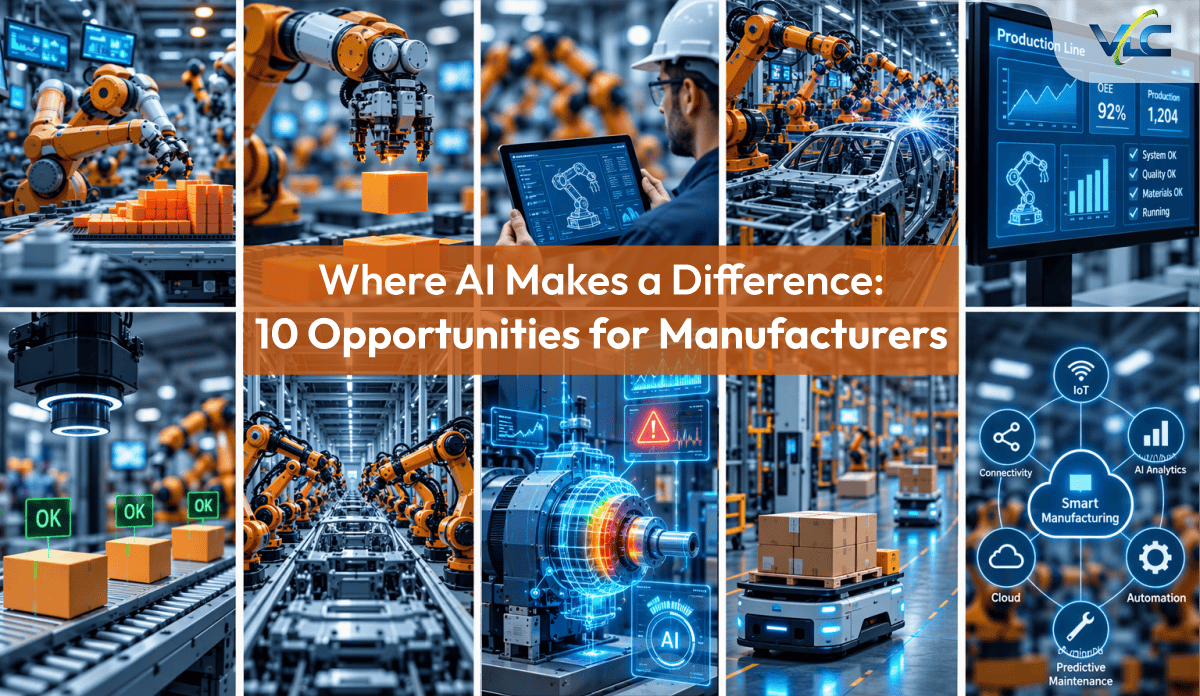
Where AI Makes a Difference: 10 Opportunities for Manufacturers
Manufacturing has never been short of data. Production lines generate machine readings, warehouses track inventory, quality teams record defects, and ERP systems hold information about orders, costs, and delivery schedules. Yet, having all this information does not automatically make operations smarter.
The real challenge is turning data into decisions before small problems become expensive disruptions.
Artificial intelligence (AI) is helping manufacturers bridge that gap. From predicting equipment failures to improving production planning, AI can help teams spot patterns, reduce repetitive work, and respond to changing conditions with greater confidence.
But where does AI actually make a difference on the manufacturing floor and across the wider business? Here are 10 practical opportunities worth exploring.
1. Predict Equipment Failures Before They Happen
Unexpected equipment breakdowns can disrupt production schedules, increase repair costs, and delay customer orders. Traditional maintenance often relies on fixed schedules or action taken after a machine fails.
AI can analyze equipment data, operating conditions, and historical maintenance records to identify patterns associated with potential failures. When combined with sensor data and condition monitoring, these insights can help maintenance teams identify warning signs earlier.
The result is a more proactive approach to maintenance, where teams can plan interventions around equipment needs instead of constantly reacting to breakdowns.
2. Improve Product Quality With AI-Powered Inspection
Quality issues are expensive, particularly when defects are discovered late in production or after products reach customers.
AI-powered computer vision can examine images of products, components, and assemblies to identify visible defects, inconsistencies, or deviations from expected standards. Depending on the application, these systems can support inspection tasks that are difficult, repetitive, or time-consuming for human operators.
AI can also help analyze quality records to identify recurring defect patterns and potential causes.
Human expertise remains essential, especially when interpreting complex defects and making final quality decisions. The opportunity lies in giving quality teams better tools to detect problems earlier and maintain consistent standards.
3. Make Production Planning More Responsive
Production planning involves balancing demand, available capacity, labor, materials, machine availability, and delivery commitments. A change in one area can affect the entire schedule.
AI can help analyze historical production data, current orders, resource availability, and changing demand to support more informed planning decisions. Advanced optimization tools can evaluate different scenarios and help planners understand the potential impact of schedule changes.
For example, if a machine becomes unavailable or an urgent order arrives, AI-assisted planning can help teams assess alternative production sequences and resource allocations.
The objective is not to remove planners from the process. It is to give them better visibility and more options when conditions change.
4. Forecast Demand With Greater Accuracy
Overestimating demand can leave manufacturers with excess inventory and tied-up working capital. Underestimating it can lead to shortages, missed orders, and production pressure.
AI can analyze historical sales, order patterns, seasonality, and other relevant business signals to support demand forecasting. When suitable data is available, it can help identify patterns that conventional forecasting approaches may overlook.
More informed forecasts can help purchasing, production, and inventory teams coordinate their plans.
Forecasts will never eliminate uncertainty. Market shifts, supply disruptions, and unexpected customer behavior can still change demand. However, better forecasting can help manufacturers prepare for a wider range of possible outcomes.
5. Optimize Inventory and Warehouse Operations
Inventory decisions have a direct impact on production continuity and cash flow. Too little stock can halt production, while too much can increase storage costs and tie up capital.
AI can help manufacturers analyze demand patterns, stock movements, lead times, and replenishment requirements to identify potential shortages or excess inventory. These insights can support more informed purchasing and replenishment decisions.
Within warehouse operations, AI can also support workload planning, picking strategies, and the identification of process bottlenecks when integrated with suitable warehouse systems.
The biggest gains often come when inventory information is connected to production schedules and purchasing data. That gives teams a clearer picture of what is available, what is needed, and what could become a problem next.
6. Reduce Energy Consumption
Energy is a significant operating expense for many manufacturers, and consumption can fluctuate with production schedules, equipment performance, and facility conditions.
AI can analyze energy usage alongside machine activity, production volumes, and operating conditions to identify unusual consumption patterns and potential efficiency improvements.
For example, a manufacturer may discover that certain equipment consumes more energy during specific operating periods or that energy usage remains high when production activity is low.
These insights can help teams investigate inefficiencies, improve equipment scheduling, and make more informed decisions about energy use. The potential savings depend on the facility, available data, and the changes implemented.
7. Strengthen Supply Chain Visibility
A delayed shipment, supplier shortage, or sudden change in material availability can affect production far beyond the purchasing department.
AI can help manufacturers analyze supplier performance, delivery histories, inventory levels, and other supply chain signals to identify potential risks. When integrated with relevant systems and data sources, it can help teams evaluate the possible impact of disruptions and consider alternatives.
This is particularly useful when manufacturers depend on multiple suppliers, operate across locations, or work with long procurement lead times.
AI cannot prevent every disruption. It can, however, help businesses recognize warning signs earlier and make decisions with a clearer understanding of the risks.
8. Preserve Knowledge and Support the Workforce
Experienced employees often carry years of practical knowledge about machines, materials, production methods, and troubleshooting. When these employees retire or move on, valuable knowledge can disappear with them.
AI can help organize and retrieve documented procedures, maintenance records, technical manuals, and historical problem-solving information. With appropriate knowledge sources and access controls, employees can use AI-powered tools to find relevant information without searching through multiple documents manually.
This can support onboarding, troubleshooting, and knowledge sharing across shifts and facilities.
The quality of the results depends on the quality of the underlying information. AI works best when manufacturers make an effort to capture expert knowledge and keep documentation accurate and accessible.
9. Automate Repetitive Administrative Work
Manufacturing involves more than making products. Teams also spend time processing documents, preparing reports, reviewing purchase orders, updating records, and coordinating information between departments.
AI can help extract information from documents, summarize reports, classify requests, and assist with routine workflows. When connected to business systems and supported by appropriate validation, it can reduce manual effort and help employees focus on exceptions that require judgment.
For example, AI-assisted document processing may help teams review supplier documents or organize incoming information for further action.
The key is to choose tasks with clear rules, measurable time savings, and manageable risks before expanding automation to more complex workflows.
10. Turn Business Data Into Better Decisions
Manufacturers often manage information across ERP, warehouse, production, quality, and financial systems. When these systems operate in silos, leadership may struggle to understand how operational changes affect business performance.
AI can help analyze connected data, identify trends, summarize information, and surface potential issues for investigation. When paired with reliable reporting and analytics, it can help decision-makers connect production performance with costs, delivery commitments, inventory, and profitability.
For instance, a production delay may affect labor costs, order fulfillment, and customer commitments. Viewing these relationships together helps teams assess the broader business impact instead of treating each issue in isolation.
AI becomes more valuable when it supports decisions across the business, not just isolated tasks on the shop floor.
Turning AI Opportunities Into Manufacturing Outcomes
These 10 opportunities show that AI is not limited to robotics or futuristic production lines. It can support everyday manufacturing decisions, from maintaining equipment and managing inventory to preserving workforce knowledge and improving financial visibility.
However, successful adoption starts with the right foundations. Manufacturers need reliable data, connected systems, clearly defined business problems, and realistic measures of success. They also need employees who understand how to use AI outputs and when human judgment should take priority.
The smartest starting point is not to adopt AI everywhere. It is to identify where better information or faster decisions could make the biggest difference.
VLC helps manufacturing businesses connect technology, data, and operational processes to support smarter decision-making and continuous improvement. Through its manufacturing-focused solutions, including Production Optimization, Visual Scheduling, Quality Management, and Maintenance Management, VLC helps businesses strengthen the systems and workflows that support efficient operations.
The goal is simple: put technology to work on real manufacturing challenges, so teams can spend less time reacting to problems and more time improving performance.